Stylish Woven Storage Baskets for Organized Living
Nghia Tran
January 23, 2026 • 6 min read
- Woven storage baskets combine traditional materials and modern design to address contemporary organizational needs efficiently.
- Material selection and weave techniques significantly influence durability, load capacity, and aesthetic versatility.
- Sustainable production and eco-conscious sourcing are increasingly critical in industry trends and consumer preferences.
- Innovations in weave patterns and natural fiber treatments optimize functional performance while preserving visual appeal.
- Integration of woven baskets into systematic storage solutions enhances spatial management in residential and commercial contexts.
The utilization of woven storage baskets transcends mere decorative appeal, positioning itself as an archetype of functional elegance within modern organizational systems. Historically rooted in artisanal craftsmanship, woven baskets have evolved through material science advances and industrial scalability, adapting to the exigencies of contemporary living spaces. This editorial examines the multifaceted dimensions of woven storage baskets, focusing on material properties, fabrication methodologies, design considerations, and their role within global market dynamics. An analytical approach underscores the interplay between sustainable practices and the escalating demand for aesthetically coherent and environmentally responsible storage solutions.
Materiality and Structural Integrity of Woven Storage Baskets
Natural Fibers: Properties and Performance
Woven storage baskets predominantly employ natural fibers such as rattan, seagrass, jute, and bamboo, each characterized by distinct mechanical and chemical properties. Rattan, notable for its high tensile strength and flexibility, provides resilience against deformation under dynamic loading conditions. Seagrass fibers exhibit high compressive resistance and moisture tolerance, rendering them suitable for humid environments. Jute, with its coarse texture and fibrous robustness, enhances the basket's structural integrity but may require treatment to mitigate biodegradation. Bamboo, due to its rapid growth cycle and high lignin content, offers a renewable yet rigid framework often utilized in hybrid weave structures. The physicochemical attributes of these fibers dictate not only the basket's load-bearing capacity but also its longevity and maintenance requirements.
Processing Techniques and Fiber Treatment
Prior to weaving, natural fibers undergo a series of preparatory processes aimed at enhancing durability and aesthetic quality. These include retting, drying, bleaching, and chemical treatments to inhibit microbial activity and prevent color fading. Retting involves microbial decomposition of non-fibrous material, facilitating fiber extraction while preserving tensile properties. Chemical treatments such as alkali soaking or natural resin coatings increase water resistance and reduce susceptibility to insect infestation. Moreover, advancements in enzymatic treatment provide an eco-friendly alternative to traditional chemical processing, maintaining fiber integrity while minimizing environmental impact. The selection and optimization of these processing methods are integral to the functional and commercial viability of woven baskets.
Design Methodologies and Functional Considerations
Weave Patterns and Their Implications
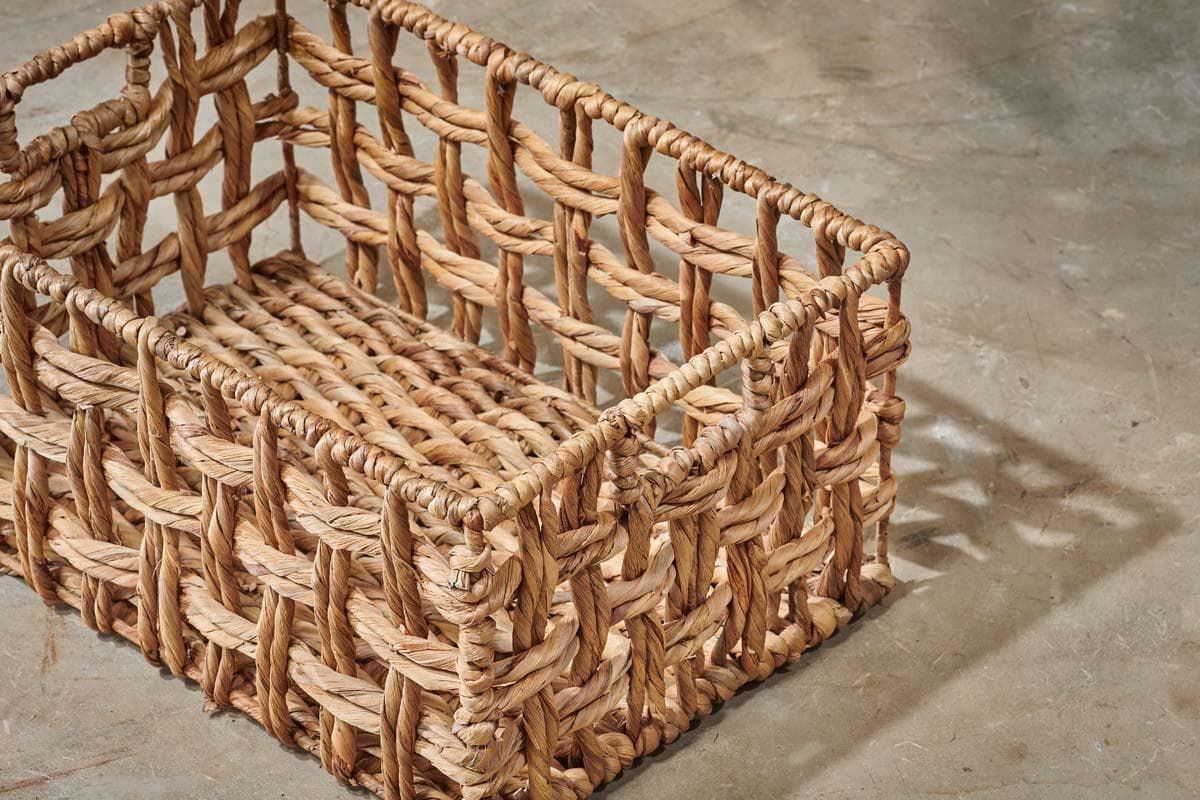
Weave patterns employed in basket manufacturing critically influence both the physical performance and the aesthetic expression of the final product. Common weave structures include plain weave, twill, and basketweave, each conferring distinct mechanical properties. Plain weave offers uniform strength distribution and simplicity in production, making it suitable for standard storage requirements. Twill weave imparts increased flexibility and elasticity, advantageous in baskets subjected to variable load geometries. Basketweave, characterized by interlacing fiber bundles, enhances thickness and rigidity, catering to heavier storage applications. Understanding the correlation between weave patterns and functional demands enables manufacturers to tailor products that meet specific use-cases, thus optimizing consumer satisfaction and reducing product failure rates.
Ergonomic and Spatial Integration
Incorporating woven storage baskets into organized living environments necessitates consideration of ergonomic factors and spatial constraints. Size, shape, and handle placement affect user interaction and ease of accessibility. Modular basket designs facilitate scalability and adaptability, allowing for dynamic configurations in various settings such as closets, kitchens, and office spaces. The dimensioning of baskets must reconcile volumetric efficiency with maneuverability, ensuring that storage solutions do not impede movement or aesthetic coherence within interiors. Additionally, contemporary design philosophies advocate for minimalist and multifunctional elements in woven baskets, promoting seamless integration into both traditional and contemporary décor paradigms.
Sustainability and Market Trends in Woven Storage Baskets
Environmental Impact and Lifecycle Analysis
The global woven storage basket industry increasingly prioritizes sustainability in response to escalating ecological concerns and regulatory frameworks. Lifecycle assessments reveal that baskets manufactured from rapidly renewable fibers such as bamboo and seagrass demonstrate a reduced carbon footprint compared to synthetic alternatives. However, environmental impacts extend beyond raw material sourcing, encompassing energy-intensive processing, chemical treatments, and end-of-life disposal. Innovations aimed at biodegradable finishes and recyclable design are pivotal in minimizing environmental burdens. Furthermore, social sustainability dimensions, including fair labor practices in fiber harvesting regions, are gaining prominence, influencing supply chain transparency and certification standards globally.
Consumer Demand and Industry Development
Current market trajectories indicate a growing consumer preference for storage solutions that amalgamate functionality, sustainability, and aesthetic refinement. The resurgence of handcrafted woven baskets aligns with increasing valuation of artisanal heritage and product authenticity. Technological advancements, such as computer-aided design (CAD) and automated weaving machinery, enable scale production while preserving intricate patterns traditionally achieved by manual craftsmanship. The industry is also witnessing diversification in applications, from decorative storage in residential spaces to organizational solutions in retail and hospitality sectors. Strategic positioning within this expanding market requires balance between innovation, cost-efficiency, and responsive adaptation to evolving consumer values.
Expert Analysis & FAQ
What are the advantages of natural fiber woven baskets over synthetic alternatives in terms of durability and environmental impact?
Natural fiber woven baskets generally excel in biodegradability and environmental compatibility due to their renewable raw materials and lower end-of-life toxicity. While synthetic fibers often surpass in mechanical durability and moisture resistance, natural fibers can be chemically treated to enhance these properties sustainably. Life cycle assessments indicate lower greenhouse gas emissions and energy consumption for natural fibers if sourced and processed responsibly. However, durability varies considerably depending on fiber choice and treatment methodology, necessitating application-specific evaluations.
How do weave patterns affect the load-bearing capacity and deformation resistance of storage baskets?
Weave patterns directly modulate the mechanical behavior of baskets. Plain weave distributes load forces evenly across the structure but may lack flexibility under uneven stress. Twill weave introduces diagonal fiber arrangements that permit minor deformation without structural failure, increasing resistance to shape distortion. Basketweave designs incorporate multiple fiber bundles interlaced to create thickness and stiffness, enhancing load capacity but potentially reducing flexibility. The selection process hinges on balancing rigidity and pliability requirements dictated by the intended storage use.
What innovations are currently being explored to improve the sustainability of woven storage baskets manufacturing?
Innovations include the application of enzymatic treatments as alternatives to harsh chemicals, reducing water and energy consumption during fiber processing. Research on hybrid fibers combining natural and recyclable synthetics aims to optimize performance while maintaining ecological benefits. Automated precision weaving using CAD technology minimizes waste and enhances reproducibility. Additionally, exploring closed-loop supply chains and fostering community-based sustainable harvesting practices contribute to ethical sourcing and reduced environmental footprint.
Can woven storage baskets be standardized for modular storage systems without compromising artisanal quality?
Modular standardization poses challenges due to the inherent variability in natural fiber dimensions and manual weaving techniques. However, incorporating semi-automated weaving processes and precise dimensional controls enables the production of consistent modular components. Hybrid approaches balance mechanization and artisan involvement, preserving quality and unique textile characteristics. This synergy allows for scalable modular storage systems adaptable to diverse spatial configurations while maintaining craftsmanship attributes valued by consumers.

-01KDWM5DVXGWCP0G4DQN08E97F.jpeg&w=1920&q=75)